

Executive Summary: Managed Detection and Response (MDR) is a proactive cybersecurity service that combines 24/7 expert monitoring, advanced behavioral analytics, and rapid remediation. Unlike traditional firewalls that only block known threats, Solidbase IT’s MDR service utilizes Managed EDR/NDR and Threat Hunting to identify and neutralize hidden attackers before they can cause damage. For Utah businesses, MDR provides an outsourced SOC (Security Operations Center) to ensure rapid incident response and compliance with regulations like HIPAA and SOC 2.
The Evolution of Utah’s Threat Landscape: Beyond the Perimeter
In Utah’s rapidly accelerating tech corridor, from the “Silicon Slopes” of Lehi to the growing enterprise hubs in Salt Lake City, the “set it and forget it” security model has become a liability. Historically, Utah businesses relied on a “castle-and-moat” strategy: a strong firewall to keep the bad guys out. However, modern cybercriminals no longer “break in” by smashing through digital gates; they “log in” using sophisticated phishing, social engineering, and stolen credentials.
Once an attacker has valid credentials, a traditional firewall sees them as a legitimate user, allowing them to bypass perimeter defenses entirely. This is why Managed Detection and Response (MDR) is no longer optional. While standard antivirus is purely reactive, stopping only what it has seen before, Solidbase IT’s MDR is proactive.
By integrating SIEM (Security Information and Event Management) with XDR (Extended Detection and Response), we create a unified security fabric. This doesn’t just watch your office computers; it provides continuous, deep-layer oversight across:
-
- Endpoints: Laptops, servers, and mobile devices.
-
- Cloud Environments: Azure, AWS, and Google Cloud workloads.
-
- Network Traffic: Identifying lateral movement that indicates an intruder is searching for your “crown jewel” data.
Why “24/7 Threat Hunting” is the New Standard
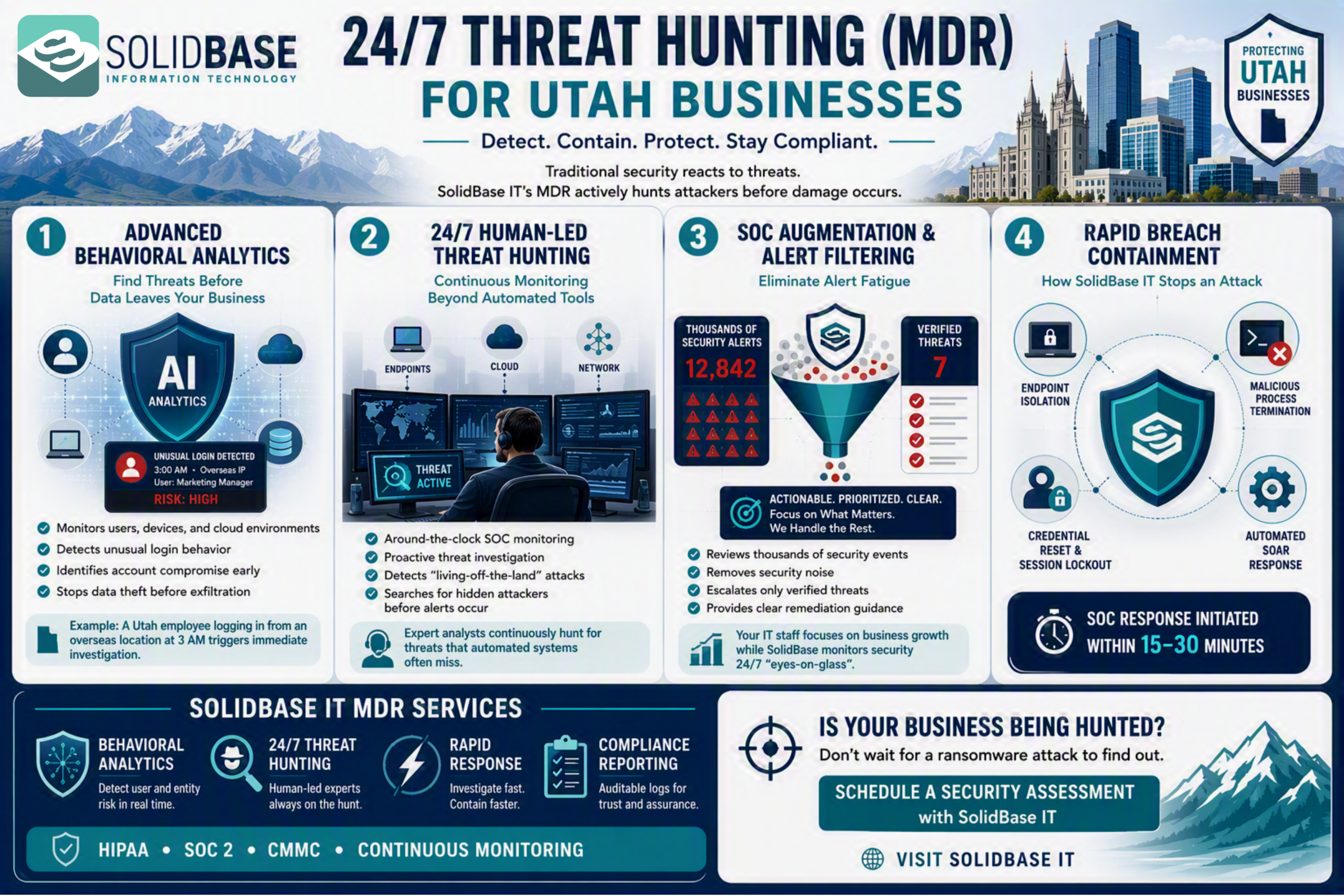
Automated security tools are excellent at catching “known” threats (like a common virus), but they struggle with “living-off-the-land” attacks where hackers use your own administrative tools against you. This is where Human-Led Threat Hunting becomes the gold standard. At Solidbase IT, our analysts don’t wait for an alarm to go off; they proactively sift through telemetry to find the subtle anomalies that automated software often misses.
We focus on two critical pillars to keep Utah businesses resilient:
1. Advanced Behavioral Analytics
We have shifted the focus from “signatures” to “behaviors.” We don’t just look for malicious files; we identify indicators of compromise (IoC) through user behavior.
Example: If a local marketing manager’s account—which typically operates 9-to-5 from Provo—suddenly begins accessing sensitive financial databases at 3:00 AM from an overseas IP address, our MDR triggers an immediate intervention. We catch the intent of the attacker before they can exfiltrate data.
2. Strategic Alert Fatigue Mitigation (SOC Augmentation)
The average Utah IT director is overwhelmed by “noise.” Thousands of low-level security pings that hide actual threats. This leads to alert fatigue, where critical warnings are accidentally ignored. Solidbase IT acts as your dedicated SOC Augmentation team. We triage, investigate, and filter the noise in the background. Your internal team is only alerted when a verified, high-priority threat requires attention, accompanied by a clear remediation plan. This allows your staff to focus on growth and innovation while we handle the 24/7 “eyes-on-glass” security.
MDR Response & Containment at Solidbase IT
1. What is the guaranteed response time for a detected threat?
Solidbase IT operates under a Rapid Response framework. For critical security incidents, our 24/7 SOC initiates an investigation within 15 to 30 minutes of detection. By utilizing SOAR (Security Orchestration, Automation, and Response), we can automate the initial “block” while our human hunters move in for deep analysis.
2. How does Solidbase IT contain a breach once it is identified?
Our containment process is immediate and surgical:
-
- Endpoint Isolation: Using Managed EDR, we can instantly disconnect an infected laptop or server from the network while maintaining a management link for our team to investigate.
-
- Process Termination: We kill malicious processes and scripts in real-time.
-
- Credential Reset: If behavioral analysis suggests account takeover, we trigger an immediate global password reset and session termination for the compromised user.
3. Does your MDR service help with compliance (HIPAA, SOC 2, CMMC)?
Yes. Solidbase IT provides comprehensive Compliance Reporting. Our MDR platform logs every detection, investigation, and remediation action. This creates an auditable trail that proves to insurers and regulators that your business is meeting the “continuous monitoring” requirements of major frameworks.
4. How is MDR different from a standard Managed Service Provider (MSP)?
A standard MSP manages your uptime and general IT health. Solidbase IT, as your security partner, provides a specialized Outsourced SOC. We focus exclusively on the “detect and respond” phase of the NIST Cybersecurity Framework, using Threat Intelligence to stay ahead of zero-day exploits.
Is your business currently being hunted? Don’t wait for a ransom note to find out. Contact Solidbase IT today for a vulnerability assessment and see how our 24/7 MDR services can fortify your Utah business against the next generation of cyber threats.
Visit Solidbase IT